Expansion Joint Selection Guide: Movement, Materials & Covers
How to specify a building expansion joint that outlives its warranty — joint width, movement class, EPDM vs TPR/TPV inserts, cover anatomy and the sealant-vs-tape-vs-cover decision, written by the group that manufactures Dseal joint systems.
Jump to a Section.
1. What Expansion Joints Actually Do
An expansion joint is a deliberate gap that lets a structure move without cracking. Concrete and steel expand and contract with temperature, sway with wind, settle with the ground and — in seismic events — need whole building blocks to move independently of each other. The joint absorbs three kinds of movement:
- Thermal movement — daily and seasonal expansion and contraction of slabs, facades and roofs.
- Seismic movement — joints break a large structure into manageable segments that move independently during an earthquake instead of tearing each other apart.
- Settlement and structural movement — differential ground settlement, loading deflection and wind sway.
Every joint system has three parts: the gap (the engineered void), the seal (the flexible bridge across it) and the framework (the structure that supports and protects the seal). Without a properly designed system, the joint becomes the building’s widest crack — the entry point for water, debris and long-term damage.
2. Joint Width & Movement Class
Two numbers define every specification: the nominal joint width on the structural drawing, and the movement class — how much of that width the system must absorb in service.
- Typical building floor joints run 1″–4″ (25–100 mm); Dseal cover systems as a family span 25 to 500 mm gaps.
- Standard Dseal floor systems accommodate ±25% thermal movement of nominal width — a 50 mm joint that can close to 37.5 mm and open to 62.5 mm.
- Seismic joints need far more — fully seismic centerbar systems are designed so the cover can survive rapid, large, multi-directional movement and return to position.
Specify from the structural engineer’s stated movement, not the gap you can see on site — an old joint measured in winter is near its widest. If the drawing is lost, tell us the joint width, location and structure age on WhatsApp and we will size the system.
3. EPDM vs TPR/TPV — What Is Actually the Difference?
This is the most-asked and worst-answered question in the joint business. Here is the straight answer.
| Property | EPDM (thermoset rubber) | TPR / TPV (thermoplastic elastomer) |
|---|---|---|
| Chemistry & processing | Ethylene propylene diene monomer, permanently cross-linked by vulcanization; cannot be re-melted | Thermoplastic rubber / thermoplastic vulcanizate blends; melt-processed, can be re-melted and re-formed |
| Service temperature | −40°C to +150°C material rating | Blended into Dseal systems rated −60°C to +125°C overall |
| UV, ozone & weathering | Excellent — the reference material for outdoor exposure | Excellent — exceptional resistance to weathering, UV and chemicals |
| Compression set / recovery | Excellent — cross-links keep sealing force over decades | Good — TPV grades approach thermoset recovery |
| Weldability | Not heat-weldable; site joints bonded with adhesives or factory-vulcanized | Heat-weldable — hot-air welded seams are homogeneous and watertight |
| Chemical resistance | Moderate; inert to acids, bases and salts | High, including harsh industrial exposure |
| Recyclability | Good (limited by cross-linking) | Excellent — fully reprocessable |
| Cost | Lower | Higher |
| Typical joint use | Compression seals, gaskets, long-exposure inserts, roofing membranes | Welded joint tapes and profiles, high-movement and chemical-exposure inserts |
The same logic applies to membrane and tape form. From our expansion joint tapes range:
| Property | TPE membranes | EPDM membranes |
|---|---|---|
| Flexibility | Excellent | Good |
| Chemical resistance | High | Moderate |
| UV resistance | Excellent | Excellent |
| Cold weather performance | Moderate | Excellent |
| Recyclability | Excellent | Good |
| Lifespan | 25+ years | 50+ years |
| Cost | Higher | Lower |
| Installation | Hot-air welding, adhesives | Adhesives, ballasting |
Rule of thumb: choose EPDM where decades of weathering and cold-climate recovery matter most; choose TPE/TPR/TPV where welded watertight continuity, chemical exposure or recyclability drive the spec. Both are manufactured under the Dseal brand — full profile catalogue at dseal.in.
4. Anatomy of a Cover System
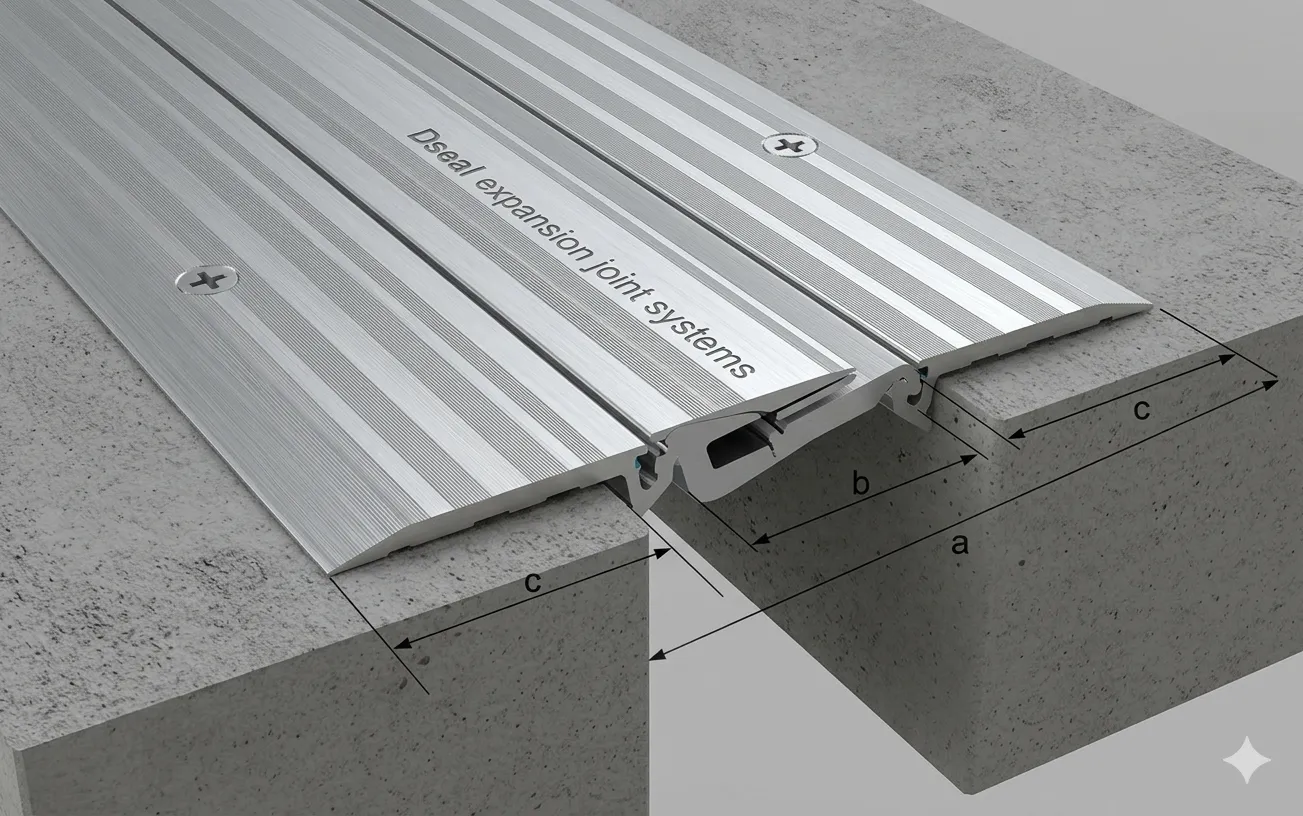
A joint cover is not a strip of metal — it is a stacked system, and every layer has a job:
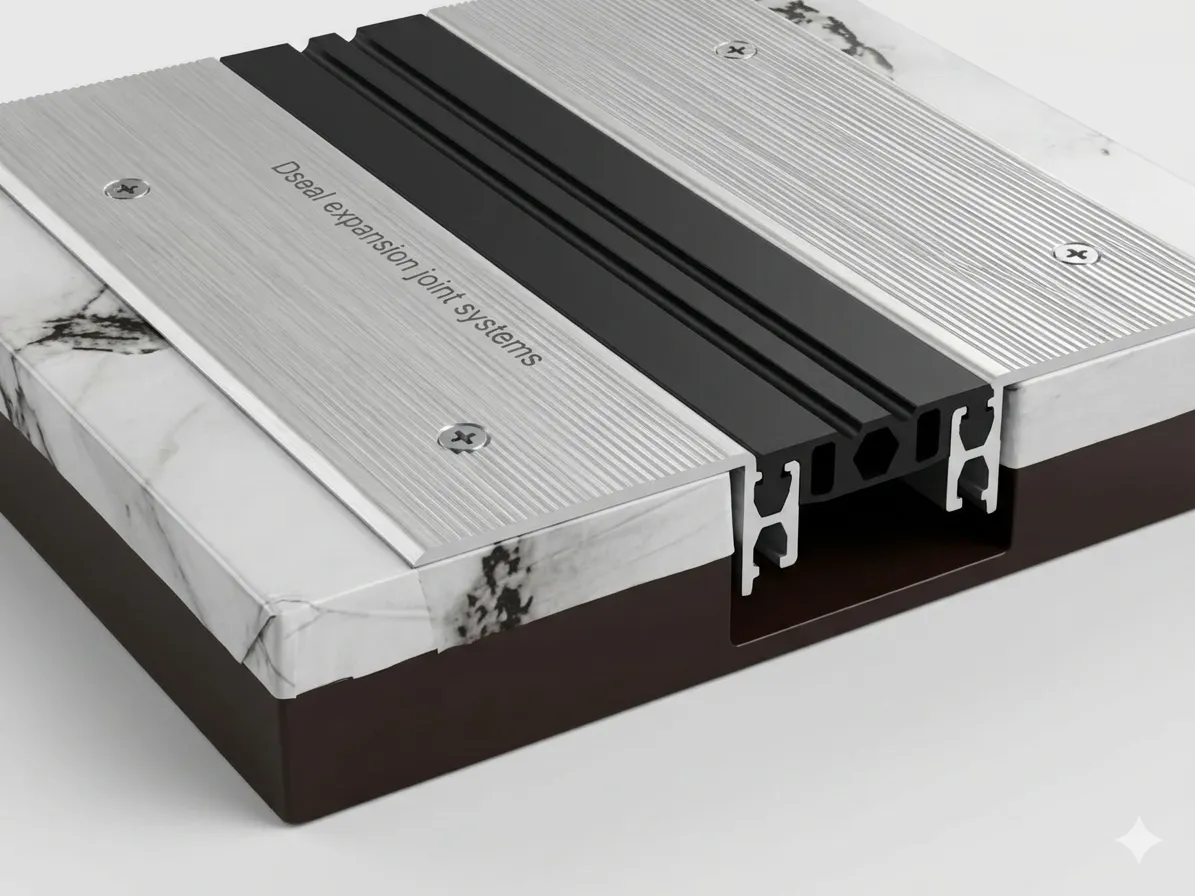
- Cover plate — aluminium (mill finish) or stainless steel, sized for the traffic: pedestrian, trolley or vehicular. Serrated surfaces add slip resistance; an integral microseal eliminates plate noise.
- Frames / retainers — anchored to each side of the gap in galvanized steel, stainless steel or aluminium; centerbar support lets wide spans carry load, and fully seismic centerbar versions handle earthquake movement.
- Elastomeric insert — the EPDM/TPR/TPV seal, often dual-durometer (firm where it grips, soft where it flexes), snap-fit into the frames.
- Water barrier membrane — a PE/PP composite gutter below the cover with fracture tensile strength ≥60 N/cm, serviceable from −40°C to +100°C and applicable even on wet surfaces. Non-negotiable on podiums and roofs.
- Fire barrier (optional) — a rated blanket in the joint void to stop fire and smoke passing between compartments; verify the rating matches the wall or floor it sits in.
- Joint filler and backer — compressible filler board (e.g. HD100 class) and backer rod controlling sealant depth at the perimeter.
5. Choosing by Location
| Location | System | Why |
|---|---|---|
| Car parks, malls, industrial floors | Floor-to-floor HD (heavy duty) | Heavy rolling loads and high-frequency traffic; serrated plates, recessed or surface-mount, 1″–4″ joints, ±25% movement |
| Lobbies, corridors, receptions | Floor-to-floor standard / male-female | Pedestrian loads; snap-fit dual-durometer seal, low-profile options, works with carpet, tile and VCT finishes |
| Slab edge meeting a wall | Floor-to-wall corner profile | Purpose-made corner geometry for residential and commercial buildings |
| Facade / vertical wall joints | Wall-to-wall box-type vertical system | Galvanized/SS/aluminium frames with EPDM or silicone seals; thermal insulation integration and load transfer |
| Roofs and terraces | Roof joint profiles with water barrier | Weatherproofing is the primary duty; membrane continuity with the roof waterproofing is critical |
| Stairs and heavy-traffic thresholds | Floor foot-step cover plates | Heavy-duty plates for stepped, high-abuse locations in commercial buildings |
| Podiums and landscaped decks | Cover system + water barrier membrane | Water standing over the joint demands a drained barrier below the cover — the most common leak point we treat |
Full profiles, sizes and drawings: Dseal expansion joint systems.
6. Sealant, Tape or Cover — Which Treatment?
Three ways to close a joint. Width, movement, traffic and water exposure make the decision:
| Route | Best for | How it works |
|---|---|---|
| Sealant-based | Narrow joints (roughly up to 25–30 mm), modest movement, walls and floors without standing water | Backer rod sized ~25% larger than the joint, then gun-applied polysulphide (Thioflex 600 class, 24–48 hour cure, service life often exceeding 20 years) or PU sealant tooled concave — see sealants |
| Tape-based | Waterproofing-critical joints, plane changes and corners, gaps up to 250 mm | TPE/EPDM band bonded or welded to each side of the joint — preformed profiles cover 75 mm (EJ 75 class) to 250 mm (EJ 250 class) gaps with high puncture resistance and elongation — see joint tapes |
| Cover-based | Trafficked joints, wide gaps (to 500 mm), seismic joints, visible architectural locations | Framed metal cover with elastomeric insert and water barrier below; the only route that carries wheeled and vehicular load — see cover systems |
The routes combine: on a podium we routinely install a water barrier and tape below with a trafficable cover above, and re-seal the perimeter in polysulphide. That combined detail is the core of our expansion joint treatment service.
7. Installation & Anchoring Basics
- Substrate first — sound, clean, dry and contaminant-free; verify actual joint dimensions against the specification before anything is fixed.
- Surface-mount vs recess-mount — surface-mounted frames suit retrofit and renovation with no block-out needed; recess-mounted systems need a preformed block-out at least 5 mm deeper than the cover assembly, planned before screeding.
- Anchoring — frames are fixed with anchor bolts at a minimum embedment of 10× the bolt diameter, using zinc-plated, hot-dip galvanized or stainless fasteners to match the exposure — see anchors & fasteners.
- Seal and barriers — install the water barrier continuous with the field waterproofing, fit the fire barrier to its rating, then the insert and plate; tool perimeter sealant smooth and concave with no air pockets.
- Inspect before handover — alignment, adhesion, fastener torque and a water test where the joint is exposed to weather.
8. Maintenance
Expansion joints are wear items with long lives, not fit-and-forget hardware. Inspect regularly — anchors and fasteners at least annually — for loose plates, torn or debonded inserts, hardened sealant and blocked drainage at water barriers. Inserts and sealants are replaceable without disturbing the frames on most Dseal systems, which is exactly the point of specifying a proper system: maintenance becomes a component swap, not a demolition. If a joint is already leaking, our treatment crews re-seal, re-insert or retrofit covers across Delhi NCR.
Expansion Joints — Frequently Asked.
What is the difference between EPDM and TPR?
EPDM is a thermoset rubber — vulcanized once into a cross-linked form that cannot be re-melted, giving outstanding weathering, cold-climate performance and 50+ year membrane life, but site joints must be adhesive-bonded. TPR (and TPV) are thermoplastic elastomers — rubber-like in service but heat-weldable and fully recyclable, with higher chemical resistance and flexibility, typically at higher cost.
Which is better for expansion joints — EPDM or TPR/TPV?
Neither universally. EPDM wins for long outdoor exposure, low temperatures and budget; TPR/TPV wins where welded watertight seams, chemical exposure or recyclability matter. Dseal manufactures inserts and tapes in both, so the joint’s location and movement decide — not the catalogue.
What joint widths can Dseal systems cover?
The Dseal family spans 25 to 500 mm gaps. Standard floor systems serve 1″–4″ (25–100 mm) joints with ±25% thermal movement; preformed tapes cover 75 to 250 mm gaps; wide and seismic joints use centerbar cover systems. See dseal.in for the full catalogue.
What temperature range do the systems handle?
EPDM as a material serves −40°C to +150°C; Dseal systems as installed assemblies are rated for −60°C to +125°C. The water barrier membrane below covers is rated −40°C to +100°C.
Do expansion joints need a fire barrier?
Wherever the joint crosses a fire-rated floor or wall, yes — the open void would otherwise pass fire and smoke between compartments. A rated fire barrier is installed in the joint before the cover, and its rating must match the element it sits in.
Can covers be retrofitted on an old leaking joint?
Yes. Surface-mounted frames are designed for retrofit — no block-out cutting needed. We remove dead sealant and filler, install a water barrier, anchor the frames (10× diameter embedment) and fit the insert and plate. This is routine work for our joint treatment service.